

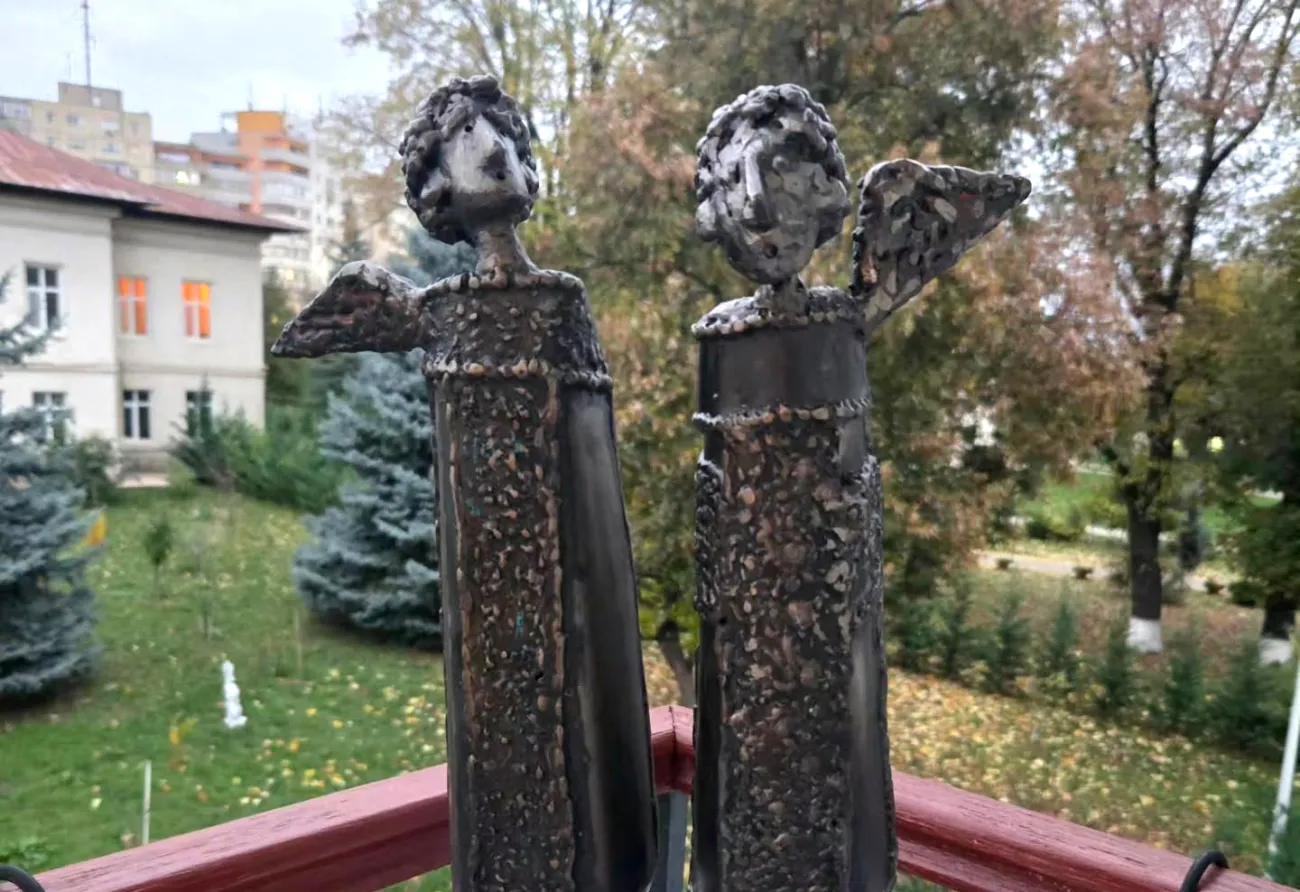

When November comes, film lovers who cherish beauty and spiritual values prepare for “Quo Vadis”. And it is not just film buffs and cinema professionals from Iași, but from all over Romania and even from abroad. Because indeed, our gathering, despite whatever impediments may stand in its way – and they do –, is a great festival of the arts and the spirit; of the arts and cinema in particular, as discoverers of God. At least that is what we all try to achieve, according to our strengths and inspirations.
In the three years since the founding and existence of the “Quo Vadis” International Film Festival, we are beginning to become a center for film and arts that build Christian spirituality, not only in Romania but also in Eastern and Central Europe, with bridges to centers of Orthodox culture - still fragile, but numerous and dynamic - across the wider world...
We initiated the festival in 2024 under the auspices of the powerful word freedom, on the occasion of the 35th anniversary of the Romanian Revolution; we continued in 2025 under the command of forgiveness, so that the political, religious, and confessional freedom gained could bear fruit in enduring artistic expressions that build the spirit. Forgiveness is what melts the barriers between people, bringing us closer to one another, making us more empathetic and open, so that this year we can find our evangelical answer to the question: Who is my neighbor? Of course, the answer will be mediated or given birth by our cinematic, human, and artistic experiences in general, brought about by the offerings of this year's edition of the festival.
So, “Who is my neighbor?” Are we still willing to go out and meet them to answer this question? Does the longing for the joy of meeting our fellow human beings still carry us, especially when the path to this soulful encounter is mined with barriers - most often internal ones - whose overcoming requires effort - both intellectual and spiritual - and is not without danger? This is, I believe, the most acute lack in contemporary society and the main psychological cause of many social cataclysms: the lack of patience, the loss of interest in listening, the lack of desire to understand our fellow human beings, the loss of the joy of communion.
We try to regain all of these through this festival: primarily through the selection of films, but also through the other connected cultural-artistic events, as well as through the joy of friendly meetings between colleagues from different meridians who share identical or similar beliefs, and between them and film lovers - that is, through the warm, soul-nourishing, and convivial atmosphere that we have accustomed you to since the first edition.
For only the care and attention toward our neighbor - Christ tells us this, but other religions intuit it too - can help us survive personally, but especially as a community, without destroying ourselves on this planet, which has become increasingly smaller, more impulsive, and even punitive toward the alterity it no longer understands, because it no longer wants to understand it. In times of crisis, “our neighbor” is the solution. Victory in spirit can only be communal.
What updates does this third edition of the festival bring us, then, taking place under the aegis of searching for the neighbor? “Who is my neighbor, who is our neighbor?” Which are the films, and who are the filmmakers and other professionals who bring us closer to our fellow human beings in this festival?
„The main sections of the festival are, as usual, the Fiction section (feature film), placed under the generic title “The World Through the Eyes of My Neighbor”, and the Documentary section – “A Window to My Neighbor”, both being non-competitive.
We are continuing the tradition of the short film screenplay competition, open to screenwriters from Romania and the Republic of Moldova, whose winners will be awarded during the festive closing night of the festival.
This year we have also launched a short film competition aimed at filmmakers from Romania and the Republic of Moldavia. The films selected for the competition can be viewed in a special section, and the laureates will be applauded during the same closing ceremony of the festival.
In the Fiction section, probably the most watched within our cinematographic forum, we have the most novelties. We will be delighted (or incited) both by the new films of some old and beloved friends of the festival, such as Yelena Popovic, Andrej Šepetkovski, Cristina Chirvasie, Nicolae Mărgineanu, but we are also bringing new names, remarkable artists of high international caliber, or young talents on the rise.
The major novelty, not to be missed by Romanian film lovers, is the presence at the festival of the talented Georgian filmmaker George Ovashvili, a favorite of major film festivals worldwide, where he has harvested a very rich record of awards, and one of the most representative contemporary filmmakers from Georgia and the Caucasus over the last two decades. We have reserved a medallion for him, within which we will see two of his recent masterpieces: Beautiful Helen (2022) and The Moon is a Father of Mine (2025), which confirm Ovashvili's directorial genius through nominations at top festivals such as Trieste and Tallinn Black Nights. Just recently, in October 2026, The Moon is a Father of Mine won the most coveted trophy of the prestigious Antalya Film Festival, the Grand Prize for Best Film. Both films impress with an unmistakable visual style: a poetics of dense silences, where simple yet rarely profound images replace dialogue, whether exploring the existential crisis of a young woman in the drama Beautiful Helen, or X-raying the painful bond between a father and a son in the wild Caucasus in the unsettling The Moon is a Father of Mine.
Probably the most anticipated by Romanian Christian film lovers is the gangster thriller with a hagiographic subtext Moses the Black (USA, 2026), by director Yelena Popovic, known to the public in Romania and around the globe for the biopic Man of God, dedicated to the life of Saint Nectarios of Aegina, a highly successful film in the Orthodox world that turned the Serbian-born director into a name highly appreciated by Christian film lovers. Her new drama, Moses the Black, transposes the story of a 4th-century saint's repentance into the underworld of today's Chicago, masterfully writing the film noir genre into spiritual-Christian themes. The film, which had its world premiere on January 20, 2026, in Los Angeles, boasts an impressive cast.
In the spectrum of ethnic-religious acculturations between the Old World and the New World falls the period drama Between Borders (directed by Mark Freiburger, released in the USA in 2025), the saga of an Armenian family who fled religious persecution from Muslim Azerbaijan to the United States during the collapse of the Soviet Union. Mark Freiburger is an independent American filmmaker focused on complex dramas with social impact and religious themes (such as Jimmy (2013), Dog Days of Summer, or Ordinary Angels). The film Between Borders evokes the religious persecution and exile of some Armenians from Baku (the capital of present-day Azerbaijan, a Muslim country) during the collapse of the Soviet Union. The production was partially filmed in Romania and features performances by several top-tier Romanian actors in supporting but substantial roles: Ana Ularu, Adrian Titieni, Sofia Pistireanu, Gabriel Spahiu, among others. The film enjoyed recognition in the religious film niche, winning the 2025 Gold Crown for Best Director and the Silver Crown (awarded by International Christian Visual Media).
Another drama about emigrating to America, this time concerning Serbs from the first half of the 20th century, will be seen in Riches (Bogatstvo, 2026), the feature film debut of our festival's friend, the Serbian actor, director, and screenwriter Andrej Šepetkovski, who was present at "“Quo Vadis” in 2024 with the short film The Service, a drama about an investigation by the Yugoslav security services in the 1960s, who descended upon a monastery to investigate a suspected coup threat, and whose aggressiveness is countered by the gentleness and Christian love of the abbess. Šepetkovski’s first feature film follows the drama of Serbian men leaving to work across the Ocean, driven by the devastating impact of World War I, which tears rural communities apart, leaving behind widows and orphans. In Riches, faith, hope, and the bond with the homeland function as pillars of moral and cultural resistance for the Serbian peasant in the face of historical oppression. The film had its national premiere in Serbia in September 2026, and Iași has the honor of hosting the film's international premiere.
A film that centers on faith, but this time in its heroic and sacrificial manifestation, is the historical-biographical drama Triumph of the Heart, the feature film debut of American filmmaker Anthony D᾽Ambrosio, a 2025 Polish-American co-production. The film evokes the heroic sacrifice of the Polish Franciscan friar Maximilian Kolbe, who offered to take the place of a prisoner in the starvation cell at Auschwitz and was subsequently canonized by the Catholic Church. This impressive Christian drama had its world premiere in Poland in 2025, followed by its US premiere and theatrical release in both countries that same year. It was honored with several awards at specialized festivals, including: the Grand Prize at the 40th edition of the “Niepokalan” International Catholic Film Festival (Poland, 2026), Best Fiction Feature Film at the Carmarthen Bay Film Festival (UK, 2026), Best Actor (protagonist Marcin Kwaśny as Father Kolbe) at the Popoli e Religioni International Religious Film Festival in Terni (Italy, 2025), and Best Feature Film at the independent Hard Faith Film Festival (USA, 2025), while also being selected and nominated at numerous other film festivals.
Romanian filmmakers enrich this year's festival offerings with two national premieres: one from a living classic and another from a female debutante in feature-length fiction, both faithful friends of our festival, alongside a fiction short film premiere.
The highly anticipated historical drama The Forgiveness (2026), by master filmmaker Nicolae Mărgineanu, continues the tragic-heroic epic of the persecution of Christians by security organs during the “Obsessive Decade ”; as in the other films of his suite dedicated to this theme, the filmmaker weaves the essential dimension of Christian repentance and forgiveness into the story. The screenplay, penned by Bogdan Adrian Toma (with whom the director previously collaborated on The Cardinal and False Treaty on the Salvation of the Soul), revisits the dramaturgical relationship between victim and executioner from the latter film, developing it this time from the perspective of the executioner's repentance.
We also salute the feature-length fiction debut of the festival's esteemed friend, Cristina Chirvasie, with Alter Eva..., a refined cinematographic essay on the contemporary challenges of femininity, crafted in 2016 but, in a mysterious way, officially offered to the public only ten years later. The author, well-known for her documentaries on prominent Romanian personalities, capitalizes on her taste for visual experimentation—previously practiced with a modesty justified by the subject matter in historical monographic documentaries—a taste for experiment that she couples with introspective reflection, yet energized by a rather extroverted rhythm. Thus, the young filmmaker demonstrates a virtuosity that harmoniously blends aesthetic and intellectual play within an experimental, partially confessional discourse, at times playful, at times grave, in which she conceives a sort of subjective and abstract self-portrait, projected into an absolute of the eternal feminine, yet permanently tensioned by a dialogue with today's world. With Alter Eva..., Cristina Chirvasie brilliantly proves her caliber as an experimental and fiction filmmaker.
Screenwriter, director, and director of photography Crînguța Pînzaru, a graduate of the famous La Fémis film school in Paris, will launch the national premiere of the short film The Way, produced by Valentin Burlacu. This is an adaptation of a novella by Father Archimandrite Nicodim Petre, which tracks the spiritual transformation within a rural community, showing how the life of a parish changes when people learn to look at the world and its hardships through the eyes of their neighbor.
The Documentary Section – “A Window to My Neighbor”, contains a few primary directions:
Documentaries with social and Christian subjects that follow the coagulation of ad-hoc Orthodox communities, centered around common actions, produced primarily for apologetic and missionary purposes, but which simultaneously breathe sincerity and authenticity.
One such film is presented to us by director and television producer Zoya Dimitrova, who specializes in Orthodox family therapy and counseling, in her documentary Happy Stones (Bulgaria, 2020), which follows how a man traumatized by the loss of his son finds peace and the meaning of life by building a chapel in the mountains through his own efforts, rallying an entire community of volunteers for its difficult construction.
Aligned with this same direction of Christian civic action, and even on a similar subject, is Aleksandar Jović’s film, Beyond the Peak (USA, 2022), the feature-length documentary debut of the young Serbian filmmaker based in America. The documentary by the US-based Serbian filmmaker follows a group of Orthodox climbers who scale a high peak to hold a memorial service there for the soul of a deceased brother. The profound bond between man and the divine is enhanced by the extreme challenges of the wilderness and the solidarity of the small team, which blends mountain climbing with prayer. The film had its world premiere in 2021 in Belgrade and circulated through university and church communities in North America before being picked up by streaming platforms. The selection of the film for “Quo Vadis” marks its international festival premiere.
The second direction of the documentary section, and its center of aesthetic, metaphysical, and symbolic gravity, is the Dmitri Brikman Medallion, dedicated to the prominent visual artist from Israel. This is “pure-blooded” visual art with deep aesthetic, symbolic, scriptural, and spiritual values. Dmitri Brikman is a major name in photographic art and the video essay; his montage films (which he calls photo-transpositions) and his photographic suites are constantly invited to important cultural centers around the world. We will therefore watch the cinematographic essays: Shadows of Jerusalem, The Ten Commandments, Jerusalem Prayer, Israel-Armenia: Eye to Eye, Ecclesiastes, and Dmitri Shostakovich's Dream of Jerusalem. This feast represents as many invitations to meditate on the aesthetics of the sacred—the densest visual expression of the unseen, of the epiphanic sublime, or of the harsh tension of archaic theophany—all contained within a single gaze, the touch of a hand, the drama of an embrace, or the calligraphy of wise wrinkles through which entire chains of generations look out. The visual editing concept, the musical score, as well as the scholarly yet restrained economy of special effects engage in a subtle dialogue with sacred texts or their memory inscribed within us, all serving the same purpose: the reawakening of the consciousness of the sacred within us, but also of a communal consciousness as children of the same Heavenly Father, regardless of our ethnic, religious, or social affiliations. This difficult path, theologically risky but essential, is one that Dmitri Brikman assumes with the utmost artistic, human, and ontological seriousness.
We will have the joy of letting ourselves be absorbed by the same profound existential and even theandric mysteries in Dmitri Brikman’s photography exhibition at the Braunstein Palace, entitled Jerusalem Is Not Just a City, which offers a spiritual-immersive experience in its own right. Dmitri Brikman's visual philosophy renders the profound ontological experience of an eternally living history, produced and enhanced by his mystical encounter with the axis mundi: Jerusalem. The lens of his camera manages to capture “the memory of things and people”, aiming to see in the eyes of his protagonists, as well as in “the breathing of the stones”, what they saw and what they suffered. A dense photography of the layers of human history and memory, where each layer is alive and speaks, and these “words”, deciphered by Dmitri Brikman's inner eye, are captured on his film.
Of course, Romanian filmmakers are also present in the documentary section “A Window to My Neighbor”.
Mara Ionescu, a benchmark name in Romanian documentary filmmaking, will present the premiere of her documentary produced by Trinitas TV, The Calling. Saint Pious Parascheva, which explores the phenomenon of the pilgrimage to Iași, transformed over the centuries into a nucleus of spiritual and identity resistance for the Romanian people and Eastern Orthodoxy. The film combines historical rigor with deeply moving testimonies, reconstructing the journey of Saint Parascheva’s relics from Epivates to Iași. The film places a special emphasis on the testimonies of contemporary pilgrims, recording the miracles and the inner resources that transform Romania’s largest pilgrimage into a profound journey toward reclaiming dignity and hope.
The well-known television journalist Ileana Gaiță, a producer within the team of the “Universul credinței” (Universe of Faith) show on TVR 1, will participate with the short documentary The House with Angels from Râșnov (2025, cinematography by Andrei Coruț). The film steps into the universe of a priest's family from Râșnov, who, alongside his wife, raises eleven children as a blessing and a divine gift. The documentary captures the way prayer, daily effort, small challenges, and joys intertwine in a home dominated by love and self-giving, where the children, though different in temperament and interests, learn from an early age the value of solidarity and mutual care.
Cinematographer and documentary director Andrei Coruț is also present with an independent production, Our Neighbor (2026), for which he provides both direction and cinematography, produced by Alexandru Ionescu with the support of the “Bucurie în Dar” (Joy as a Gift) Association. The short film tracks the philanthropic and social actions of the Christian Association, showing how involvement in the lives of those who suffer becomes a catalyst for the entire community.
Last but not least, the wholehearted and hardworking friend of our festival, director Cristina Chirvasie, as part of the project “Revoluția modelelor – Real. Asumat. Cu sens” (The Revolution of Role Models – Real. Committed. Meaningful), will offer audiences in Iași, Neamț, and Botoșani a recent selection of her portrait-films dedicated to exemplary figures of Romanian culture and spirituality, namely: Năvodarul Duhului. Părintele Constantin Galeriu (2023), Limanul. Silvia Radu (2024), and Copilul lui Dumnezeu. Dorel Zaica (2024).
The “Quo Vadis” Creative Competitions
Starting this year, we have added a short film competition (without specifying the genre) to the fiction short film screenplay competition, both open to screenwriters and filmmakers from Romania and the Republic of Moldavia and held under the powerful theme “My Neighbor”.
We were delighted to notice how the quality of the candidate screenplays has increased since last year, with this year's competition for the three prizes being very tight. The jury, composed (for both competitions) of Elena Dulgheru, Violeta Gorgos, Cristina Chirvasie, and Cătălin Jeckel, designated the following laureates of the screenplay competition:
- First Prize (€500): Distanța dintre noi (The Distance Between Us) – by Sebastian Bădărău
- Second Prize (€300): Dresorii de câini (The Dog Trainers) – by Dan Mihalcea
- Third Prize (€200): Cine este aproapele meu (Who Is My Neighbor) – by Gabriel Gabor Balint,
- Special Mentions: Sărbători fericite (Happy Holidays) – by Daniel Nuțescu and Un simplu like (A Simple Like) by Răzvan-Gabriel Dutchevici.
In the short film competition, the jury awarded only two of the three planned prizes:
- First Prize (€800): Casa neagră (The Black House) – by Dumitru Grosei
- Second Prize (€600): Dincolo de mai aproape (Beyond Closer) – by Steliana Blaga
- Third Prize (€400): not awarded.
All short films selected for the competition, namely: Ca un fel de cântec despre viață dar altfel (Like a Kind of Song About Life, But Different) by Bogdan Georgescu; Casa neagră (The Black House) by Dumitru Grosei; Îndrăzneală și impas (Boldness and Impasse) by Ion Buteanu; Beyond Closer by Steliana Blaga; Little Angel by Eva Maria Lupeș; and DOGMA '71 by Ștefan Marcu, will screen at the Iași National Athenaeum on November 11, 2026, with the award-winning short films receiving an additional screening during the closing ceremony.
Elena Dulgheru, Artistic Director of the “Quo Vadis” Festival
